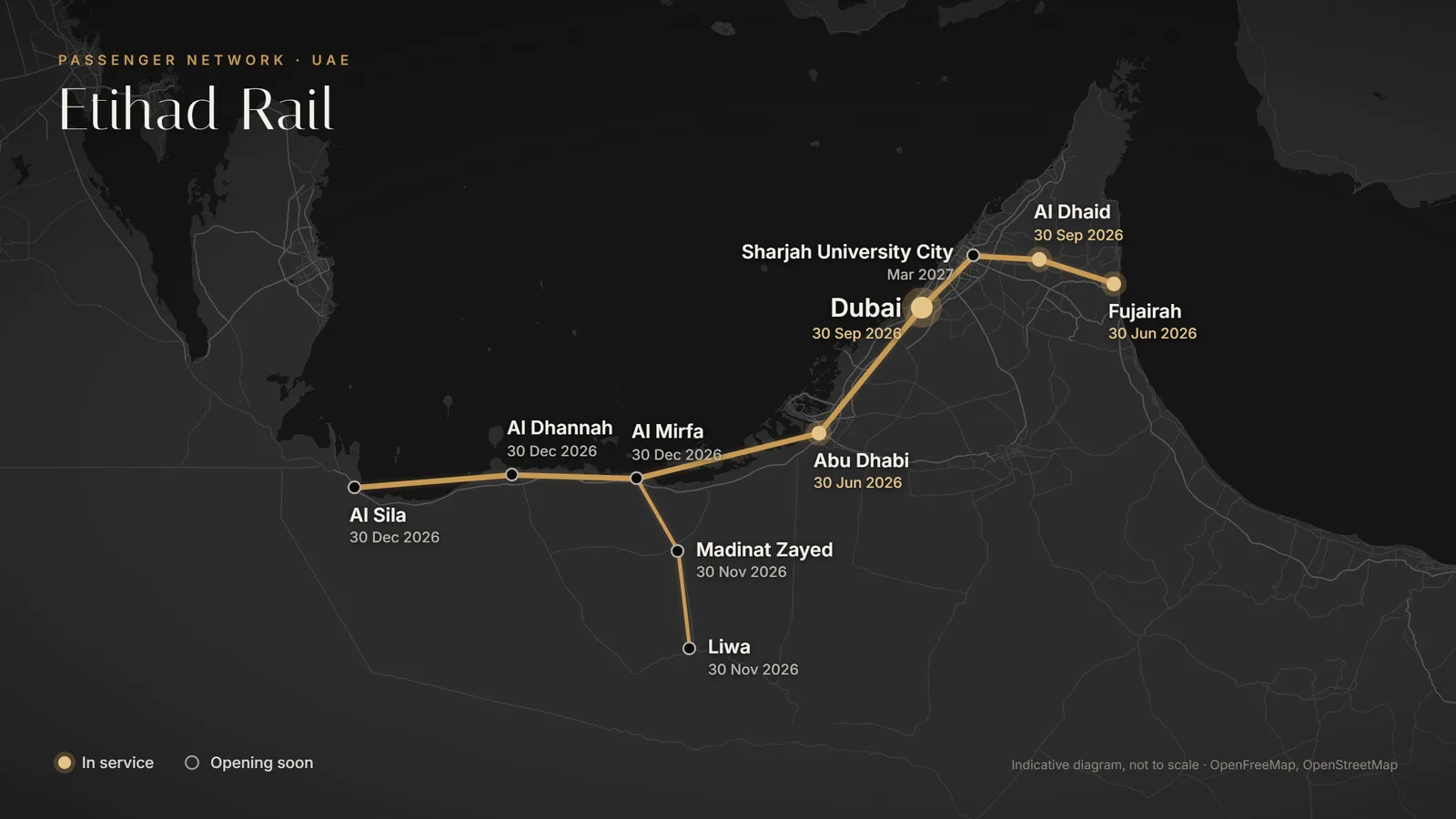
On 28 September Etihad Rail's Dubai station was inaugurated, and since the 30th passenger trains have linked Abu Dhabi, Dubai and Fujairah. Fares start at AED 39 in Comfort class and AED 109 in Premium. For a country that has always moved by car, this is a change of scale.
For property investors, the news is not the train itself. It is where it stops.
A station joined to the Metro
The Dubai station is in Al Yalayis and is connected by a pedestrian bridge to the Jumeirah Golf Estates Metro station. With the Nol system, a single QR code covers train, Metro, tram and bus. In practice, anyone living along the Metro can reach the train to Abu Dhabi or Fujairah without taking the car.
In plain terms, Dubai and Abu Dhabi become a little more of a single market. People who work in one city and live in the other have a real alternative to the motorway, and the right home becomes the one close to the hub, as well as to the office.
A network switching on station by station
The passenger service started on 30 June between Abu Dhabi and Fujairah. At the end of September, Dubai and Al Dhaid in Sharjah were added. Madinat Zayed and Liwa open on 30 November, Al Mirfa, Al Dhannah and Al Sila on 30 December, and Sharjah's University City at the end of March 2027.
The timetable is public, station by station. The service is run by a joint venture between Etihad Rail and Keolis, one of Europe's leading public transport operators.
The areas that benefit first
The first to feel the effect are the areas around the station: Jumeirah Golf Estates, Al Furjan, Discovery Gardens and, a little further west, Jebel Ali. These neighbourhoods had already been brought closer to the centre by the Metro line to Expo City, and today they also become Dubai's gateway to the rest of the Emirates.
Two projects in my Selection sit in this part of the city. John Richmond District by MIRA, in Al Furjan, offers homes furnished by John Richmond, with studios from AED 994,500 and half the price after handover. Raw District by Imtiaz, in Jebel Ali, is a mixed-use district with furnished homes, co-working and a cinema, a 50/50 plan and handover in late 2029.
Rail works over the long run
Transport infrastructure is not read in a quarter. It is read over ten years, and it works mainly on two things: rental demand and ease of resale. A train joining the country's cities widens the pool of people who can live in a neighbourhood. And a wider pool is the basis of any steady rental income.
Dubai is building this on two levels, with the Metro inside the city and the train between cities. Buying near the right hubs means buying into that too.
If you want to understand which areas are already inside this network, and how far they are on foot from the stations, write to me. I read every message personally and reply within 24 hours.
Antonio