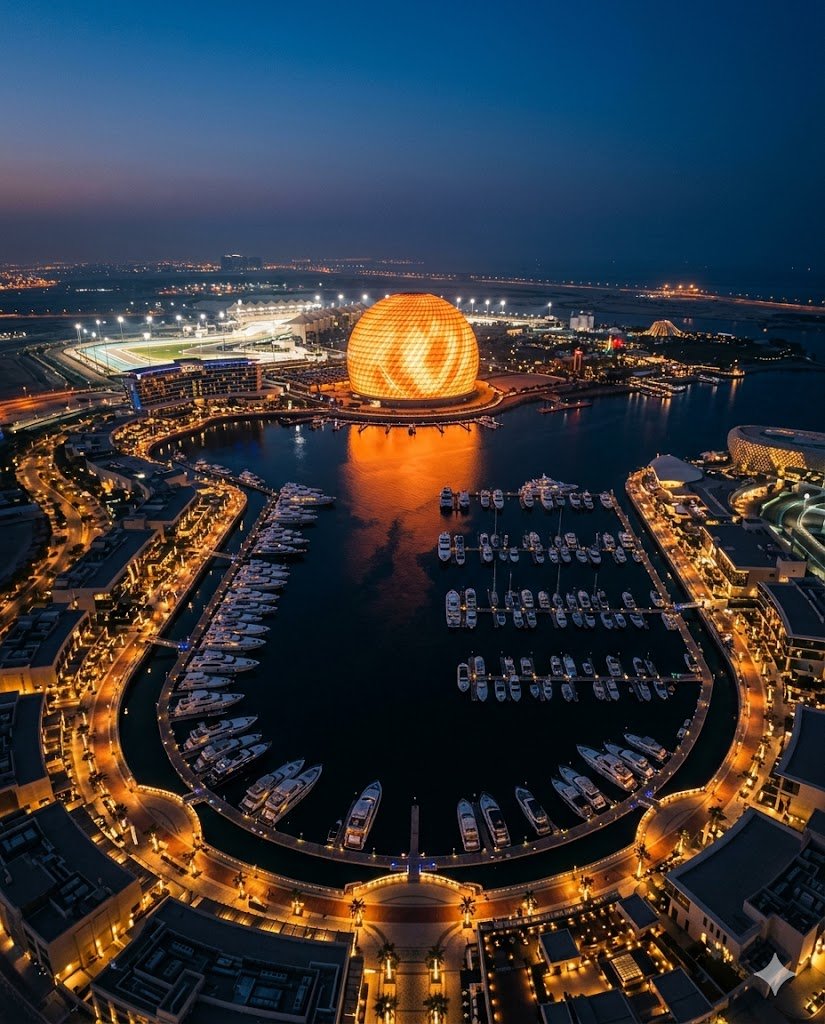
On 14 May 2026, Abu Dhabi's Department of Culture and Tourism and Sphere Entertainment Co. announced something genuinely new: Yas Island will host the first Sphere outside the United States. This is a $1.7 billion venue, with capacity for up to 20,000 people and an opening planned for the end of 2029. Just nine days later, on 23 May, the construction contract was officially awarded to ALEC Engineering.
This is not a rendering or a promise on paper. These are two separate corporate announcements, backed by public financial commitments, a real construction site and a firm delivery date.
From my desk here in Dubai, where I have followed the Emirati property market for years, I read this news differently. An announcement of this scale is not simply entertainment news: it is a powerful property signal. Let me explain why.
The Sphere is not a theme park. It is a permanent demand engine.
The distinction matters for anyone weighing up a property investment in Abu Dhabi in 2026.
A traditional theme park generates a seasonal, standardised flow of visitors: families with children, school holidays, queues at the turnstiles. A venue built for concert residencies, immersive experiences and global sporting events does something else entirely. It gives people a reason to visit the island twelve months a year.
The model follows the Las Vegas Sphere, resting on three programming pillars: Sphere Experiences (proprietary, ongoing immersive productions), music residencies (concerts by Arab, regional and international artists), marquee events (combat sports, world-class conferences and major brand launches). On top of that, the Sphere will serve as an iconic backdrop during the global live broadcasts of the Yas Marina Formula 1 Grand Prix.
In property terms, this is not an attraction you exhaust in an afternoon. It is an engine that will keep professionals, tourists and enthusiasts booking a serviced apartment for the weekend, every weekend, for years to come.
In the industry, this is known as the anchor attraction effect. An iconic draw does not only boost tourism: it sends demand for housing in the surrounding area sharply higher, for both short-term rentals and luxury residences. The precise figures on the economic impact of the Las Vegas Sphere often come from private sources, so I treat them with caution (it is worth remembering that Las Vegas operates inside a $55 billion tourism market, according to LVCVA 2024 data). The structural logic, though, is identical. Abu Dhabi is building version 2.0 of that bet, dropping it into an ecosystem that is already mature.
Yas Island: the ecosystem the Sphere amplifies.
Even before the Sphere was announced, Yas Island had already established itself as the densest entertainment district in the entire Middle East. Assets already up and running: Ferrari World, Warner Bros. World and Yas Waterworld, SeaWorld Abu Dhabi and Etihad Arena, the Yas Marina Formula 1 circuit, Yas Mall and the acclaimed Yas Links golf course.
The 2025 annual passes sold out well before the season opened. I mention this not as marketing, but to give a real measure of how stretched demand already is against the existing infrastructure, before you even add a $1.7 billion venue.
The Sphere will be built strategically between Yas Mall and SeaWorld, a short distance from Zayed International Airport. A position that captures both the airport flow and the existing residential base.
To all this you can add the arrival of Disney. The Walt Disney Company and Miral have announced a theme park resort on Yas Island: it will be Disney's seventh park worldwide and the first built from scratch since the Shanghai joint venture in 2016. There is no official date yet (industry estimates point to a 2030–2033 window), and it is worth being clear about this: many developers present the project as if it were already finished, but it will take time.
Here is how I read it: when billions of institutional money converge on a single stretch of land, the whole area is repriced before a single gate opens. Property prices are simply the consequence.
Abu Dhabi property market: the baseline numbers.
Gross rental yields on Yas Island average around 7% for apartments (2025 data, market aggregates from Bayut and Bhomes). Abu Dhabi's macroeconomic data needs no embellishment to be compelling.
In 2025, property transactions reached AED 142 billion, marking a 44% rise in value and a 52% rise in volume on the previous year (official sources: ADREC and the Abu Dhabi Media Office, February 2026). That is 42,800 transactions in a single year.
The most interesting figure for anyone investing from overseas? 72% of investment in the freehold zones (those open to foreigners) comes from international capital, for a total of AED 54.13 billion. Foreign direct investment (FDI) grew by 13%, reaching AED 8.2 billion.
Read superficially, this might look like a speculative bubble. Read properly, the trends reveal a market that was already drawing institutional capital well before the Sphere announcement. The project rests on economic foundations that were already solid.
Yas Island rental yields and prices: what the data shows.
On Yas Island, the median price sits at around AED 2.3 million, with annual growth estimated at between 5% and 6%. The main portals put gross yields for apartments at around 7% on average. As for entry points, you are looking at roughly AED 700,000 (about $191,000) for a studio, AED 1.4 million (about $381,000) for a one-bedroom and over AED 3 million (about $817,000) for a villa.
A note on transparency: these aggregated figures come from private portals and agencies (such as Bayut and Bhomes). They should be treated as orders of magnitude, not as official ADREC statistics, since real yields vary dramatically depending on unit size, floor, aspect and the reliability of the developer. Past performance does not predict future performance.
A clear example of the island's potential is the success of the Waldorf Astoria Residences Yas, developed by Aldar in partnership with Hilton. Announced in May 2025, this luxury project of 133 units (with a total value of around AED 850 million, about $231 million) sold out on its first day of launch, with prices starting from AED 3.8 million (about $1.03 million). That shows the market's appetite for branded residences on the island, though it says nothing about the pricing of future supply or the resale timelines of other unit types.
Analysts' projections suggest that proximity to the Sphere will become a strong point of differentiation, with demand for short-term rentals of smaller units (studios, one-bedrooms and serviced apartments) expected to grow. That is a forecast from real estate agencies, not data: I treat it as such.
Sobha City Abu Dhabi: what an AED 40 billion debut actually means.
Another significant signal for the Abu Dhabi property market in 2026 is the expansion of Sobha Realty. The developer, renowned for its exceptionally high build quality in the Emirati market, has chosen Abu Dhabi for its first major project outside Dubai.
The result is Sobha City, in the Al Bahiya corridor, close to Zayed Airport: a multi-year development of 38 million square feet that will house around 6,580 units across apartments, villas and mansions.
One inaccurate claim doing the rounds in the media needs correcting: the figure of AED 40 billion (about $10.9 billion) represents the total estimated value of the project in its entirety, not the amount sold to date. What is on the market right now is Phase 1 (around a third of the scheme), with handovers scheduled for the fourth quarter of 2029. Starting prices put one-bedrooms at AED 1.31 million (about $357,000) and villas at AED 4.96 million (about $1.35 million).
This is not "sold out at 40 billion". It is a top-tier developer that has chosen this area as its first position outside its home market. That is the signal.
Al Reem Island vs Saadiyat Island: two investment strategies, not two versions of the same thing.
People approaching the Abu Dhabi market often make the mistake of treating every area as the same. In reality, areas like Al Reem and Saadiyat follow opposite financial rationales.
Al Reem Island remains the most accessible mid-tier segment in Abu Dhabi: gross yield around 7.49% on apartments, studio entry points below AED 820,000 (about $223,000), three-bedrooms around AED 2.61 million (about $711,000). The area has a solid tenant base: expats, families, and public-sector professionals working in the capital. It is not a speculative area or one tied to pure hype: it is the area of consistent, stable cash flow.
Al Reem Island: the case for cash flow
Saadiyat plays a different game entirely: capital appreciation. Here the logic is wealth positioning and luxury. Saadiyat Island runs on a different logic, and anyone reading it as a high-yield zone has it wrong. Gross rental income sits around 4.05% for apartments. A one-bedroom starts at AED 2.58 million (about $702,000). You do not buy Saadiyat for the annual yield: you buy it for long-term capital appreciation and for the exclusivity of the setting.
Saadiyat Island: the case for capital appreciation
With the Louvre open, the Guggenheim under construction, international universities and residential complexes of the highest calibre, the person buying on Saadiyat is not optimising the monthly return: they are adding a liquid, prestigious asset to their portfolio in an area that grows by deliberate policy, not by speculation.
The figures on Al Reem and Saadiyat come from private portals and market aggregators: I cite them as orders of magnitude with significant variability between units, not as an official survey.
The UAE Golden Visa threshold: why it is a consequence, not a reason to buy.
The Golden Visa threshold stays at AED 2 million (about $545,000) of property value for the renewable ten-year residency. Since 2025 the AED 1 million (about $272,000) minimum down-payment requirement has been removed: even a financed property, from an approved developer, qualifies for the visa, under the procedures in force at the date of this article.
In concrete terms: a one-bedroom on Yas Island already puts you in the Golden Visa band. A three-bedroom on Al Reem, the same.
The rule I always share is this: the Golden Visa is the consequence of the investment, not its cause. If the investment thesis stands on the numbers, the visa is an added benefit. If the thesis only stands because the visa is attached, it is not a thesis. It is an emotion with a legal signature on top.
Buy well for what you actually want. The visa will follow.
Abu Dhabi real estate in 2026: a reading for investors watching from abroad.
I will not tell you it is urgent to buy now. That line belongs to the salespeople I do not respect, and I will never use it.
What I will say is that in 2025 Abu Dhabi changed its structure, not just its numbers. The foreign capital coming in is not real estate tourism: it is allocation by people weighing the soundness of a market, the quality of the developer, the liquidity of resale. The $1.7 billion Sphere on Yas Island is the institutional seal on that transition: not a speculative project, but a commitment by DCT Abu Dhabi, visible, with a contractor appointed and a date.
For anyone who already holds a position in Dubai, Abu Dhabi can be the second cycle. It moves at a slower pace, with a different kind of liquidity, in a market that does not overlap with its neighbour. For anyone who has not yet bought anything in the Emirates, it offers more measured entry points than Dubai presents today, with top-tier developers active in the area.
The segments most exposed to the upside, if the Sphere thesis plays out as permanent programming, are the small units and the serviced apartments: the para-tourist visitor flow the venue generates is different from the flow of families with children who live on the island. These are considerations to hold in the reasoning, not guarantees.
If you have a defined budget, a clear time horizon and you want an honest read on which areas and which unit types are worth considering now, write to me. I will reply personally. Also worth reading: our analysis of Dubai's Jebel Ali Downtown arbitrage window and Downtown Dubai vs Dubai Islands vs Jebel Ali: a full 2026 comparison.
Antonio Giannetti